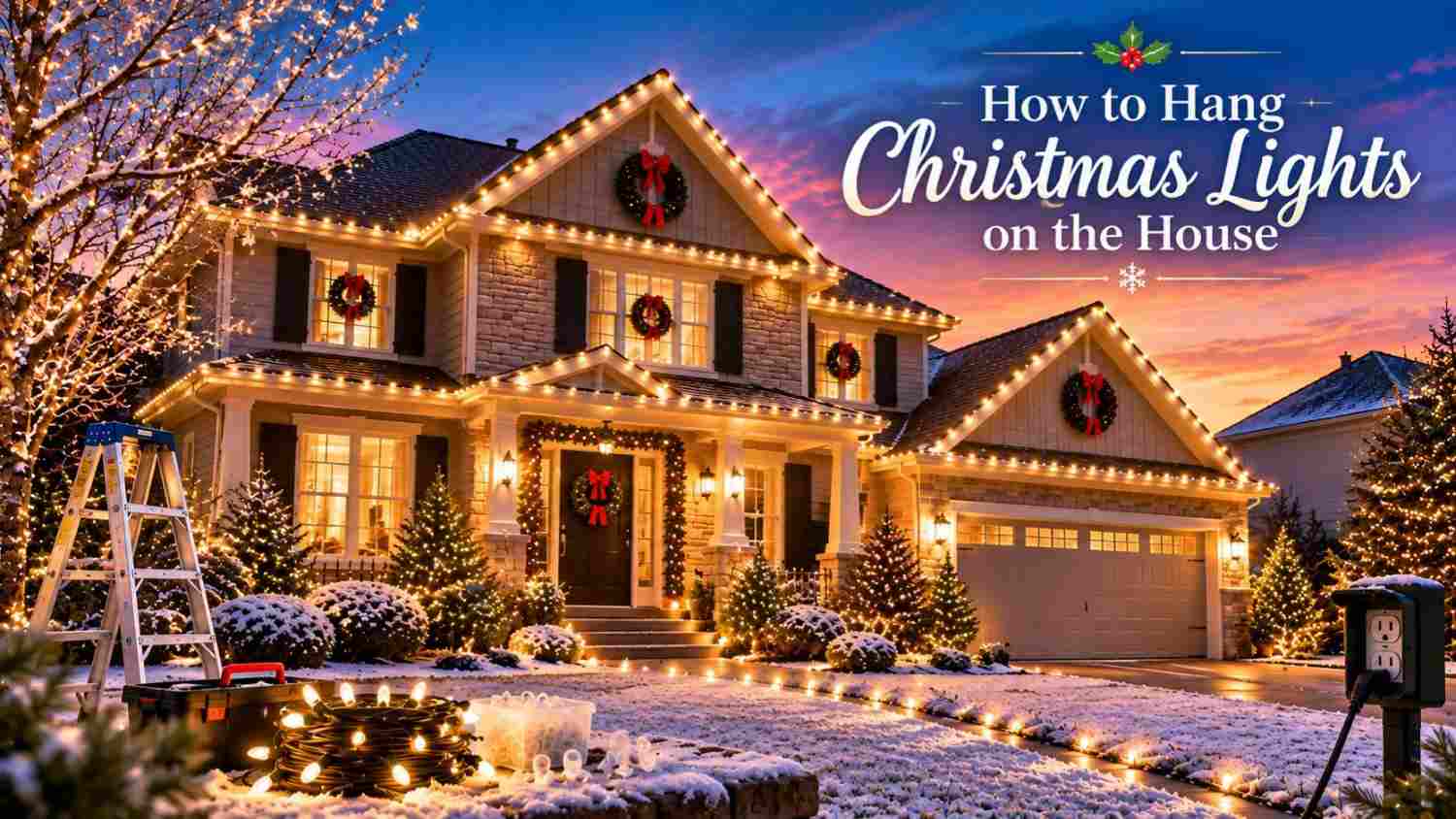
Every December, the same two houses show up on every street: the one with a crisp, evenly spaced light line along the roof, and the one with a sagging string held up by a single nail and a prayer. The difference almost never comes down to better lights. It comes down to matching the right clip to the right surface when you hang Christmas lights on the house, gutter clips for open gutters, shingle tabs where there’s no gutter, magnetic clips for steel, masonry-rated adhesive for stucco and brick, and seam hooks for siding. Get that match right and the lights practically hang themselves.
This guide covers every surface you’re likely to run into, plus the two situations most guides skip entirely: homes with gutter guards, and stucco exteriors.
Planning Before You Hang Christmas Lights on the House
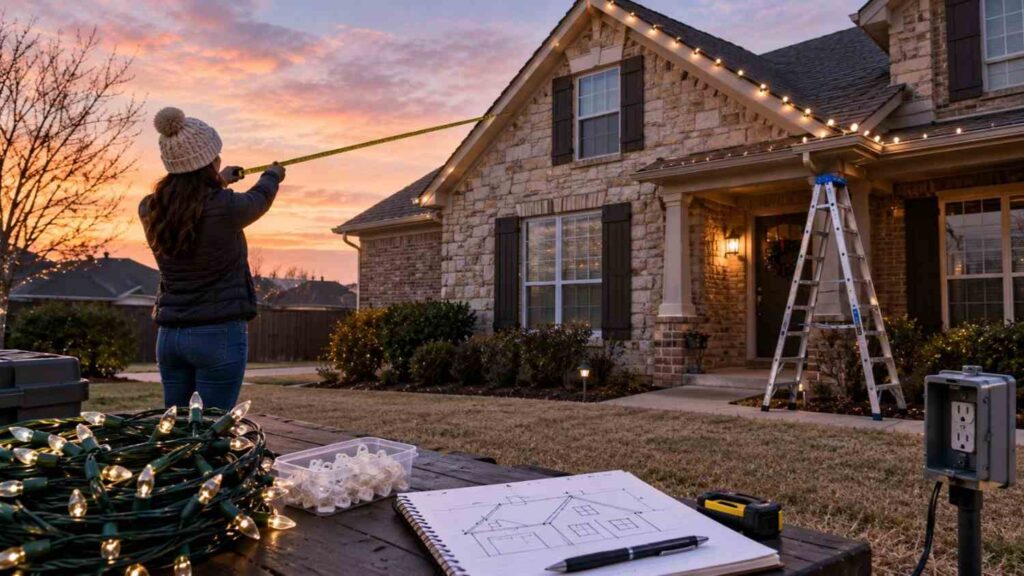
Walk your house from the street and decide what you actually want lit, just the roofline, or the roofline plus windows, columns, and a walkway. Measure the total run, including corners, and add about 10% extra length for sag and connectors. Count your power sources too. Most single 15-amp outdoor circuits handle around 1,800 watts, so LED strands give you far more room before needing a second circuit, and if you’re extending the display into a patio or backyard area, the electrical math for hanging outdoor string lights works the same way across a longer run.
Choosing Your Lights: C6, C7, C9, LED, or Incandescent
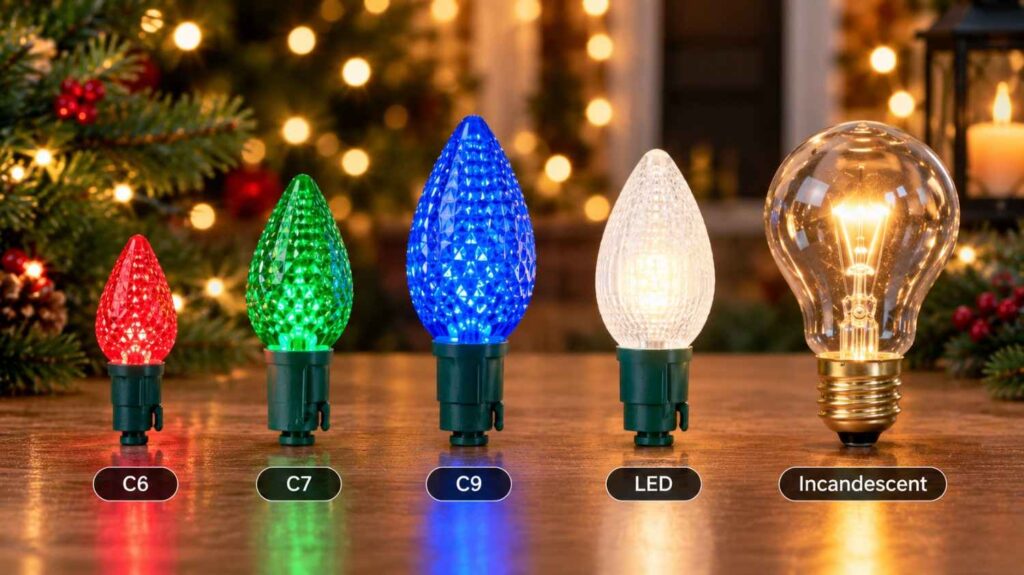
| Type | Size | Best For |
| C6 | Smallest strawberry bulb | Windows, delicate trim |
| C7 | Mid-size, classic look | Rooflines, doorways |
| C9 | Largest, boldest glow | Rooflines, main focal lines |
| Icicle lights | Hangs down in strands | Gutters, roof edges |
| LED | Any shape, low wattage | Anywhere, most efficient choice |
| Incandescent | Any shape, higher wattage | Traditional warm glow, shorter runs |
LED strands use roughly 70% less energy than incandescent strands of the same size, which is also why LED setups allow far more strands to be safely connected end to end (see the table further down).
The Right Clip for Every Surface
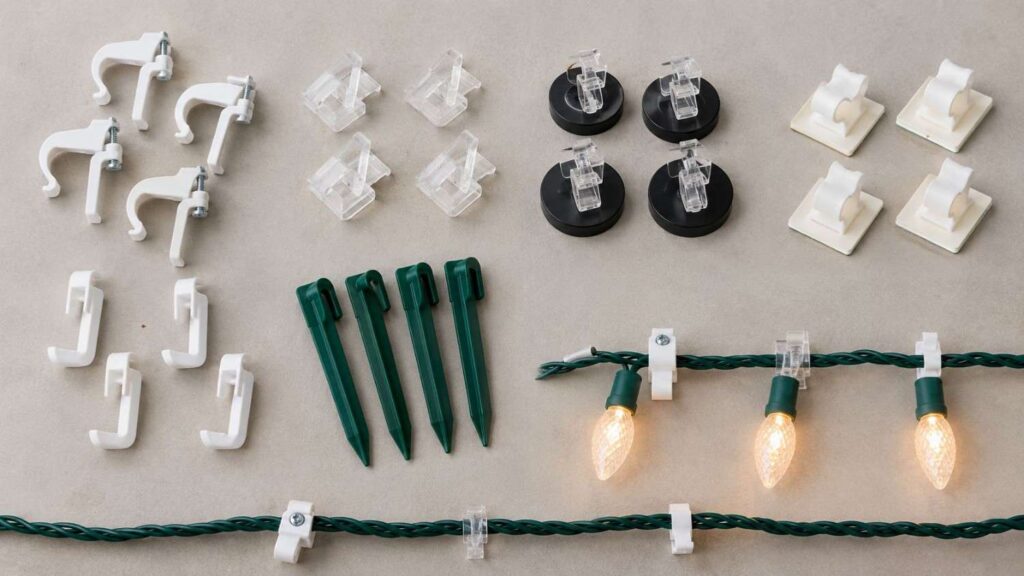
| Surface | Best Attachment Method | Tools Needed |
| Open gutters | Clip-style hooks over the lip | None |
| Roofline, no gutter | Shingle tab clips | None |
| Gutter guards | Guard-compatible clips or fascia mount | None |
| Steel doors, railings, lintels | Magnetic clips | None |
| Stucco | Masonry-rated adhesive clips | Adhesive, cure time |
| Vinyl or aluminum siding | Seam hooks in panel gaps | None |
| Brick or masonry | Adhesive clips, or anchor above at gutter | Adhesive |
| Windows, doors, columns | Adhesive clips | Adhesive |
| Walkways, beds, yard | Ground stakes | None |
Hanging Method, By Surface
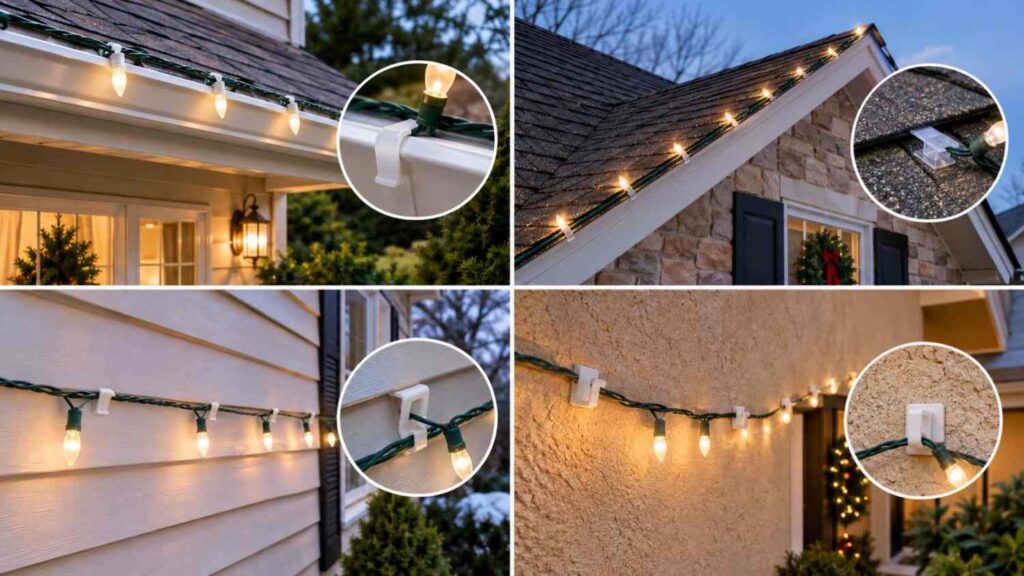
Gutters
Standard aluminum or vinyl gutters take clip-style hooks that hang directly over the lip, no tools required. Space clips every 8 to 12 inches so the line doesn’t sag between points.
Mistake to avoid: spacing clips too far apart to save a few dollars. A sagging line looks worse than no lights at all.
Rooflines Without a Gutter
Gable ends and some roof edges have nothing to clip onto. Shingle tab clips slide up under the bottom row of shingles and hold the bulb at the roof edge, nothing glued, nothing nailed.
Mistake to avoid: installing on a frozen or very cold roof. Cold shingles are brittle and can crack when a tab is forced underneath. Wait for a milder day.
Homes With Gutter Guards
This is the situation most hanging guides ignore completely, and it’s common enough that it deserves its own method. A standard gutter clip built to hook under a bare gutter lip often can’t grip once a guard covers that lip, and forcing one on can bend or crack the guard.
- Use guard-compatible clips with a wider, flatter jaw that grips the guard’s surface without pinching or puncturing it.
- Attach to the fascia board instead, when exposed fascia is available just below the guard line.
- Avoid sharp spring-action clips on mesh-style guards. They can puncture the mesh and create a weak point.
- If your guard is solid rather than mesh, adhesive clips rated for outdoor metal can work as a backup.
Mistake to avoid: forcing a standard gutter clip onto a guard because it’s what you already own. It’s the fastest way to bend a guard out of shape.
Steel Surfaces
Steel garage door frames, steel lintels above windows, and metal railings all take magnetic clips, the fastest install method there is. The magnet grabs the surface, the clip holds the bulb, done.
Mistake to avoid: assuming your gutters or siding are steel. Aluminum and vinyl are far more common, and magnets slide right off them. Test with a small magnet before you buy a full set.
Stucco Exteriors
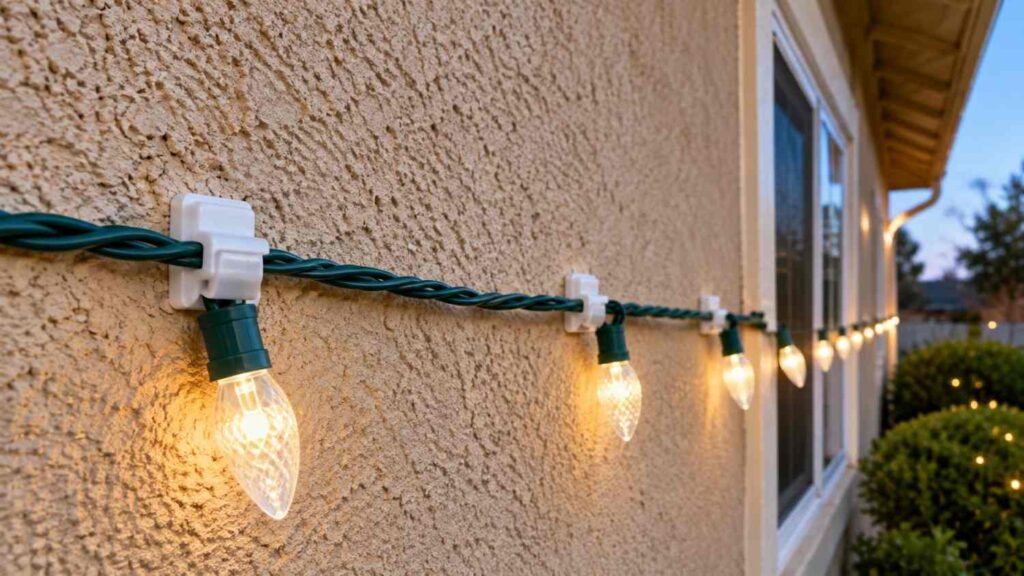
Stucco is brittle and porous, and it’s one of the easiest surfaces to damage with the wrong method.
| Step | What to Do |
| 1 | Anchor above or below the stucco whenever possible (gutter or fascia) |
| 2 | If attaching directly, use masonry-rated adhesive clips, not plastic hooks |
| 3 | Let adhesive cure fully (usually 24 hours) before hanging weight |
| 4 | Never nail or screw into stucco without a masonry anchor |
| 5 | Remove clips slowly at takedown, pulling parallel to the wall |
| 6 | Patch any chip with stucco caulk matched to your wall color |
Mistake to avoid: pulling adhesive clips straight off the wall at takedown. Pulling outward instead of parallel is what takes a chip of stucco with it.
Vinyl or Aluminum Siding
Never drill into siding, it cracks vinyl and dents aluminum. Slim siding hooks slide into the horizontal seams between panels and lock in place with no adhesive and no holes.
Mistake to avoid: forcing a hook into a caulked or sealed seam. If it won’t slide in with light pressure, move over a few inches.
Brick or Masonry
Outdoor-rated adhesive clips work for light-duty runs on smooth brick or mortar joints. For a full roofline, it’s usually easier to anchor at the gutter above the brick instead.
Mistake to avoid: relying on adhesive clips for a heavy, continuous run. They’re built for light-duty strings, not a full C9 line.
Windows, Doors, and Columns
Adhesive clips are the standard here since there’s rarely anything to hook onto. Apply them on a mild day, most outdoor adhesives need surface temps above about 50°F to bond properly.
Walkways, Beds, and Yard Level
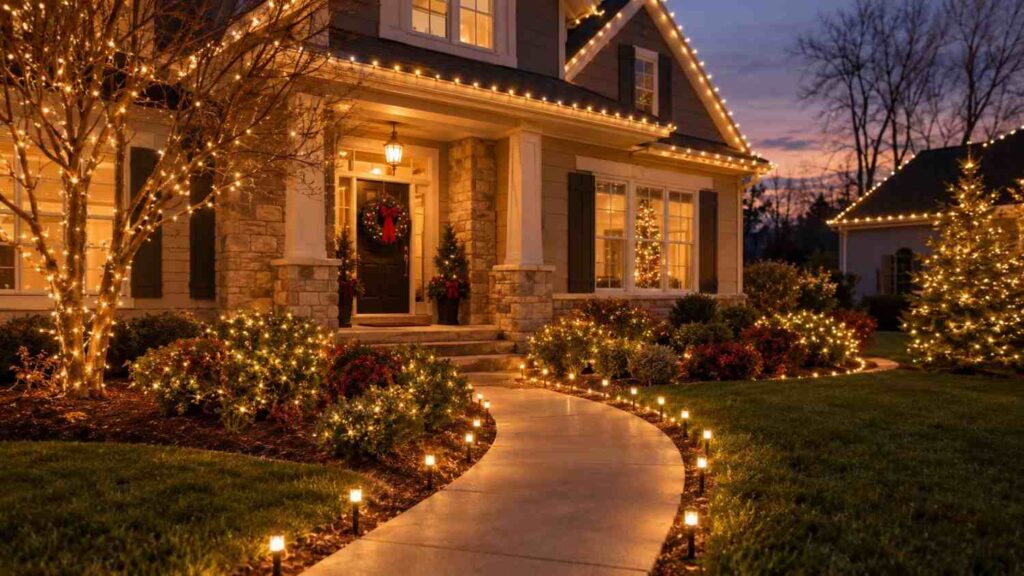
Half of a great display never touches the house at all. Ground stakes hold light lines along walkways, driveways, and bed edges at a consistent height.
Mistake to avoid: running cord across open lawn where it gets walked on or mowed. Stake the line and route cords along beds instead.
How Many Strands Can You Connect?
| Light Type | Typical Wattage per Strand | Strands You Can Usually Connect |
| Incandescent | 40 to 140 watts | 3 to 5 end to end |
| LED | 3 to 7 watts | Often 20 or more |
Always check the tag on your specific lights, limits vary by manufacturer. Test each strand before it goes up, since a section that won’t light usually comes down to a blown fuse, a loose bulb, or a damaged socket rather than a bad strand entirely.
Safety Notes
- Add an extra clip on either side of any corner or transition point. That’s where lines pull loose first in windy conditions.
- Avoid installing on extremely hot afternoons. Adhesive bonds better and stucco flexes less in cooler morning or evening temps.
- On roof peaks, work from the ladder, never the roof itself, with a second person holding the base. Falls account for over 40% of holiday decorating injuries treated in emergency rooms each season.
- Check your HOA’s posted dates before you start, if you belong to one.
FAQ
How do you hang Christmas lights on the house without nails?
Use clips matched to your surface: gutter clips, shingle tabs, guard-compatible clips, magnetic clips for steel, or adhesive clips for stucco and brick.
Can you hang Christmas lights if you have gutter guards?
Yes, use wider guard-compatible clips or attach to exposed fascia below the guard line instead.
How do you hang Christmas lights on stucco without cracking it?
Anchor above or below the stucco whenever possible. If attaching directly, use masonry-rated adhesive clips, never nails.
How do you hang Christmas lights on brick without damaging it?
Use adhesive clips rated for masonry, or anchor at the gutter above the brick instead.
How do you hang lights on a roofline with no gutter?
Use shingle tab clips that slide under the bottom row of shingles, no drilling or gluing needed.
How many strands of Christmas lights can you connect together?
Incandescent strands are usually limited to 3 to 5 end to end. LED strands allow far more. Check the tag on your lights.
Do Christmas lights need a GFCI outlet?
Yes, any outdoor light connection should run through a GFCI-protected outlet.
How do you keep Christmas lights from blowing off in the wind?
Space clips every 8 to 12 inches and add extra clips at corners, where lines pull loose first.
How far apart should light clips be spaced?
Every 8 to 12 inches on rooflines to prevent sagging.
When should you put up Christmas lights?
Most homeowners start in early to mid November, but check your HOA’s posted dates first if you have one.
Conclusion
However you approach it, the way you hang Christmas lights on the house comes down to matching the right clip to the right surface, gutter, no-gutter roofline, guard, steel, stucco, or brick. Plan first, respect wattage limits, and prioritize ladder safety. Get that right and your display holds up all season.
If you’d rather skip the ladder entirely, The Works Lighting Services designs and installs holiday lighting from start to finish, including stucco and gutter-guard setups.